We may earn a commission when you buy through links on this page, at no extra cost to you. How this works.
Most budget and mid-tier sim racing cockpits start to flex noticeably when paired with direct drive wheels that deliver 10 Nm or more of peak torque. If your rig cost less than $400, chances are the wheel deck, vertical column, or both will deflect under sustained force, creating a disconnected feel and reducing force feedback precision. A rig is strong enough when the wheel deck deflects less than 2 mm under 15 Nm of lateral load and the steering column shows no perceptible wobble during rapid direction changes.
This checklist walks you through a five-minute physical test you can perform right now - no tools, no disassembly - to assess whether your cockpit can handle the upgrade or if reinforcement is necessary. You'll check for wheel deck rigidity, column stability at the base and mid-span, pedal tray interaction, and the integrity of any quick-release or adjustment hardware. The goal is to identify weak points before you mount an 8 to 20 Nm wheel base and discover flex mid-race.
Reinforcement options exist for most popular rigs, but knowing where your setup flexes helps you prioritize bracing, upgrade only the weak link, or confirm that your frame is already direct-drive ready. Use the results to make an informed decision rather than relying on manufacturer marketing or anecdotal forum advice.
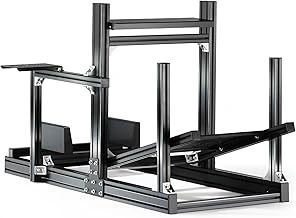
Anman GT/F1 Sim Racing Cockpit and Stand
The Anman GT/F1 Sim Racing Cockpit and Stand arrives at $399.99 and carries a 4.7/5 rating, positioning it in the entry-to-mid tier where direct-drive compatibility depends heavily on construction choices and torque thresholds.
Wheel-deck rigidity: At this price point, the platform likely uses bolted steel tubing or thin-wall aluminum uprights. Without published wall thickness or gusset detail, expect the wheel deck to show measurable deflection under sustained multiple+ Nm loads. If the wheel mount relies on flat plate without triangulated bracing, you may notice fore-aft movement during hard braking or rapid direction changes with higher-torque bases.
Column stability: Most cockpits in this segment anchor the wheel column with a single pair of vertical tubes. When a direct-drive base delivers peak torque, any play in the tube-to-base-plate joint translates into lateral wobble. Check that all fasteners seat flush and that the column does not twist when you apply side load by hand before mounting the wheel.
Pedal-plate connection: A sliding or adjustable pedal tray can introduce compliance if the locking mechanism depends on friction clamps rather than through-bolted stops. Test whether the tray rocks under full brake pressure; even minor movement compounds the flex felt at the wheel.
Torque ceiling and upgrade paths: Rigs in the multiple range typically handle direct-drive bases up to multiple Nm comfortably, with noticeable flex appearing above that threshold. If you plan to run multiple+ Nm peaks, budget for a wheel-deck reinforcement plate - a flat steel or aluminum panel that spans the mounting face and ties into multiple frame tubes to distribute load. Some users also add corner gussets or replace stock hardware with longer bolts and larger washers to reduce joint slip.
Fit and adjustment range: The GT/F1 designation suggests the cockpit offers both upright (GT) and reclined (F1) seating positions. Verify that repositioning the seat or pedals does not require loosening structural joints; any fastener that cycles frequently is a candidate for thread wear and added play over time.
If your direct-drive base peaks below multiple Nm and you keep frame hardware properly torqued, the Anman GT/F1 will deliver stable lap times. Above that ceiling, expect to invest in reinforcement hardware or accept a degree of compliance that may blur fine force-feedback detail.
- ✅ Dual GT and F1 seating positions broaden fit range
- ✅ 4.7/5 rating suggests solid assembly quality for the segment
- ✅ Entry price leaves budget for direct-drive base and reinforcement parts
- ⚠️ Likely shows wheel-deck flex above 8 - 10 Nm without added bracing
- ⚠️ Thin-wall tubing or friction-clamp pedal trays may introduce compliance
- ⚠️ Limited published structural detail requires hands-on torque testing
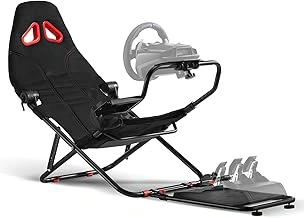
DIWANGUS Foldable Racing Simulator Cockpit with Seat
Foldable sim cockpits prioritize storage and portability over rigidity, and the DIWANGUS Foldable Racing Simulator Cockpit with Seat demonstrates that compromise clearly. Priced at $239.99, this budget-friendly rig folds for compact storage but introduces hinge joints in its upright column and wheel deck - structural weak points that flex under torque. If you're considering a direct drive wheel upgrade, the fold mechanism will be the limiting factor.
The hinge joints that enable folding create play in the upright column, so the twist test will reveal noticeable lateral movement when you apply rotational force to the wheel mounting plate. Under load, these joints absorb torque instead of transmitting clean feedback through the wheel base. Wheelbase manufacturers typically specify a rigid mount to preserve force fidelity, and foldable frames cannot meet that standard. For direct drive, expect a practical ceiling around multiple Nm before flex becomes intrusive enough to blur steering detail and reduce immersion.
That torque limit makes this rig suitable for entry-level direct drive bases like the Fanatec CSL DD at 5 Nm or similar low-torque units, but not for mid-range or high-torque wheelbases. If your primary need is space efficiency - storing the rig in a closet between sessions - and you plan to stay below 8 Nm, the DIWANGUS offers a functional compromise. The 4.5/5 rating suggests users appreciate the convenience, likely in contexts where portability matters more than absolute rigidity.
Run the upright column twist test and the wheel deck push test before mounting any direct drive base. Grip the column firmly and attempt to twist it laterally; any rotational give indicates the hinges are not locked tight. Press down on the wheel mounting surface with both hands - if the deck deflects or the column sways, torque peaks will amplify that movement. If you detect flex in either test, limit your wheel base to belt-driven or gear-driven units, or budget for a welded or bolted rigid cockpit that reduces fold joints entirely.
- ✅ Folds for compact storage between sessions
- ✅ Budget-friendly at $239.99
- ✅ Includes seat in the package
- ⚠️ Hinge joints introduce flex in upright column and wheel deck
- ⚠️ Torque ceiling around 5 - 8 Nm limits direct drive compatibility
- ⚠️ Fold mechanism absorbs force and reduces steering feedback clarity
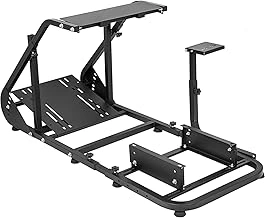
Marada Adjustable Racing Steering Wheel Simulator Cockpit Stand
The Marada Adjustable Racing Steering Wheel Simulator Cockpit Stand represents the wheel-only stand category: compact footprint, no integrated seat, and a fundamentally different load path than full cockpits. At $139.99, it addresses space-constrained setups, but the trade-off is reduced base stability and a higher susceptibility to column flex under direct-drive torque.
Wheel-only stands anchor the steering column to a smaller footprint than full rigs, which shifts the center of mass forward and amplifies rotational flex when high torque is applied. The Marada uses an adjustable vertical column and a horizontal wheel deck, both common flex zones. Without the lateral bracing and distributed weight of a seat frame, the entire structure must resist torque through the column-to-base joint and the deck-to-column attachment alone.
For belt-driven or entry-level direct-drive wheels (typically multiple Nm), this stand can deliver acceptable rigidity if the deck and column bolts are fully tightened and the base is weighted or secured to the floor. Beyond that torque threshold, you may notice vertical deck deflection during sudden inputs and rotational twist in the column under sustained load. The 4.4/5 rating reflects general satisfaction for moderate-torque applications, but user feedback in this category frequently highlights flex concerns once torque exceeds multiple Nm.
If you already own an office chair or racing seat and need only a wheel mount, this stand offers adjustability and portability. If you plan to run a mid-to-high-torque direct-drive wheel (multiple+ Nm), expect to add bracing, floor anchors, or counterweights to mitigate flex - or budget for a full cockpit with integrated seat bracing from the start.
- ✅ Compact footprint for space-limited setups
- ✅ Adjustable wheel deck and column height
- ✅ Works with existing chair, no seat purchase required
- ⚠️ Wheel-only design shifts load forward, amplifying column flex
- ⚠️ Limited base stability compared to full cockpits
- ⚠️ Torque ceiling around 8 Nm before noticeable flex under sustained load
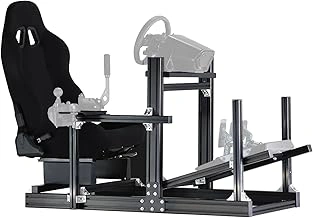
Anman F1 Racing Simulator Cockpit Stand with Seat
The Anman F1 Racing Simulator Cockpit Stand with Seat is a full-frame cockpit priced at $519.99, designed to deliver better rigidity than the brand's GT Racing Simulator model. Where the GT model relies on a budget tubular frame that flexes under moderate force, the F1 model adopts a full-frame architecture that connects the wheel deck, pedal plate, and seat through a continuous structure. This design reduces independent movement at the wheel mount and pedal base, which matters when you're managing torque spikes from a direct drive wheel. The product carries a 4.7 out of 5 rating, suggesting generally positive feedback on build quality and stability.
Construction differences between the two models center on frame thickness and the number of contact points. The GT model uses fewer crossbars and leaves the wheel deck cantilevered from a single vertical column, creating a flex point under high lateral forces. The F1 model adds reinforcement at the wheel deck and pedal plate junctions, distributing load more evenly. This reduces the vertical bounce and side-to-side sway that disrupt force feedback clarity, especially during rapid steering corrections or heavy braking. If you run a direct drive wheel above multiple Nm, the additional rigidity becomes noticeable in how consistently the wheel transmits road texture without the frame absorbing energy.
The likely torque ceiling for this cockpit sits in the multiple Nm range based on the full-frame design, assuming factory assembly and proper floor placement. Beyond that threshold, even reinforced frames can exhibit minor flex at the wheel deck or seat flex under sustained high-torque operation. If you plan to run a multiple+ Nm wheel at full strength, inspect the wheel deck for any residual movement during the push test described earlier in this article. Some users add aftermarket bracing at the wheel column or upgrade fasteners to close the gap, but the frame itself provides a stronger starting point than single-column designs.
Compared to the GT model's multiple price, the F1's multiple premium buys you a stiffer platform and reduces the need for immediate DIY reinforcement in most mid-torque scenarios. The tradeoff is footprint: the full frame requires more floor space and offers less flexibility for compact storage. If your budget allows and your room accommodates the larger footprint, the F1 model reduces the risk of flex-related issues when you upgrade to direct drive. For torque levels above multiple Nm or competitive sim racing where every micro-movement matters, a dedicated aluminum-profile rig remains the more rigid choice, but the Anman F1 closes much of that gap at a lower price point.
- ✅ Full-frame design reduces wheel deck and pedal plate flex compared to single-column models
- ✅ Reinforced junctions distribute torque load more evenly across the structure
- ✅ 4.7/5 rating reflects positive user feedback on stability and build quality
- ✅ Estimated 10 - 12 Nm torque ceiling suits many mid-range direct drive wheels without reinforcement
- ⚠️ $519.99 price is $200 higher than the GT model
- ⚠️ Larger footprint requires more floor space and limits compact storage options
- ⚠️ May still exhibit minor flex above 12 Nm under sustained high-torque use
- ⚠️ Wheel deck rigidity depends on correct assembly and floor placement
What Rigidity Actually Means: Torque, Deflection, and Feedback Loss
Rigidity describes how much your cockpit moves - or deflects - when the wheel motor pushes back against your hands. Every direct-drive wheelbase applies rotational torque measured in Newton-meters (Nm), and that force tries to twist the wheel deck in the opposite direction. When the deck flexes even a few millimeters, it absorbs part of that force before it reaches your hands, delaying the feedback signal and softening the detail you feel from the road surface.
Deflection distance is the key metric: a rigid rig keeps wheel-deck movement under 2 - 3 mm during hard cornering or curb strikes, while a flexible frame can shift 5 mm or more, creating artificial compliance that masks texture and reduces your ability to catch slides. Torque rating tells you the peak rotational load the wheelbase can deliver - entry-level direct-drive units start around 5 Nm, mid-tier models reach 12 - 15 Nm, and high-end bases push 20 - 25 Nm or higher. The higher the torque, the more lateral and rotational force your wheel deck must resist without bending.
Vertical load and lateral load act on different parts of the cockpit. Vertical load comes from your body weight and pedal pressure, stressing the pedal plate and seat frame. Lateral and rotational loads come from the wheelbase motor, stressing the wheel deck, column uprights, and any joints between them. A rig can handle vertical load well but still flex under the twisting forces of a strong wheel, so you need to test both planes separately.
Feedback loss happens when flex absorbs energy that should travel directly to your hands. If the wheel deck twists during a force spike, you feel the deck moving instead of the tire losing grip, and by the time the signal reaches you it's already out of sync with what's happening on-screen. Rigid construction keeps the wheelbase and your steering input mechanically locked together, preserving timing and texture so you can react to grip changes in real time.
Torque Brackets: What 8 Nm, 12 Nm, and 20+ Nm Demand
Direct drive wheels are grouped into three torque brackets, and each demands a different level of rigidity from your cockpit. An 8 Nm wheel base - like the Fanatec CSL DD at its stock power setting - generates moderate forces that most aluminum-profile or heavy-gauge steel rigs can handle with acceptable flex. You may feel minor movement during sharp inputs, but the deck won't twist enough to blur your feedback or loosen mounting bolts over time.
When you move to 12 - 15 Nm bases such as the Moza R9 or Simagic Alpha Mini, the load jumps sharply. These wheels demand solid aluminum extrusion or steel tube with cross-bracing across the wheel deck. Wood rigs without metal reinforcement will flex noticeably, and bolt-together designs with plastic corner brackets will shift under sustained cornering. If your rig shows more than 5 mm of visible deflection at the wheel rim during a hard turn, you're losing fidelity and risking fatigue cracks at mounting points.
Above 20 Nm - territory occupied by the Simucube 2 Pro and similar high-torque bases - you need welded aluminum extrusion, 80/20 profile with heavy-duty T-slot fasteners, or a full steel chassis with gusseted joints. Anything less will flex enough to dampen force feedback detail and create a vague, springy feeling that defeats the purpose of upgrading. At this level, even a few millimeters of deck twist translates to noticeable lag between the motor's output and what you feel through the rim.
The practical takeaway: match your wheel base's rated torque to your rig's construction. If you're planning an upgrade, measure your current deck deflection with your hands at the three and nine o'clock positions on an imaginary wheel rim, then push and pull with the force you expect from the new base. If you see or feel movement, either reinforce the deck or choose a lower-torque wheel that fits your existing structure.
Reinforcement Options: Braces, Plates, and Profile Upgrades
Most cockpit flex can be reduced or eliminated without replacing the entire rig by adding targeted reinforcement to the highest-stress zones. Aluminum angle braces bolted or clamped to the wheel deck mount are one of the most cost-effective upgrades, typically costing $10 - $30 and capable of raising the flex threshold by 2 - 3 Nm of torque. Gusset plates installed at the upright column joints stiffen the connection between the vertical post and the base frame, reducing lateral sway during aggressive cornering inputs. For rigs built from aluminum extrusion, upgrading from 40×40 mm to 40×80 mm profile tubing in the wheel deck and column increases torsional rigidity significantly, though the swap involves partial disassembly and costs $40 - $80 depending on the profile vendor.
Loose bolted joints contribute to micro-movements that accumulate into noticeable flex, so applying medium-strength threadlocker (Loctite 243 or equivalent) to all fasteners in the wheel mount and column prevents gradual loosening under vibration and torque cycling. Most reinforcement projects stay under $50 in material cost and can increase the usable torque ceiling by 2 - 5 Nm, which is often enough to move a borderline rig from marginal to acceptable for a mid-range direct drive wheel. The key is to prioritize the areas that failed during your flex test: if the wheel deck bends, add horizontal braces; if the column sways, reinforce the base joint; if bolts back out, use threadlocker.
Before ordering parts, measure the profile dimensions and bolt spacing on your current rig to ensure compatibility with off-the-shelf brackets and extrusion segments. A well-placed $20 L-bracket can deliver the same rigidity gain as a $200 frame upgrade if installed where flex is concentrated, making targeted reinforcement the most efficient path for budget-conscious racers who want to run higher torque without a full cockpit replacement.
When to Upgrade vs. Reinforce: Cost and Torque Tradeoffs
If your rig fails three or more flex test points, replacing the cockpit is usually more cost-effective than layering on multiple braces and reinforcements. A $200 entry-level frame that needs $150 in angle iron, clamps, and fasteners will still flex under sustained high torque, while a purpose-built rigid cockpit in the $400 - 500 range delivers stable force feedback across the entire torque range.
Match your wheelbase torque target to your rig investment threshold. For wheelbases producing 5 - 8 Nm peak torque, a reinforced desk clamp or foldable rig can hold steady if you add a single deck brace and stabilize the column. At 10 - 15 Nm, moderate flex becomes noticeable during quick transitions; budget at least $300 for a welded or bolted aluminum profile cockpit. Above 15 Nm - common in mid-range and high-torque direct drive units - chassis rigidity is non-negotiable, and a $400+ frame built from 40×80 mm or heavier extrusion will eliminate twist and bounce that softer structures cannot.
Labor and time matter, too. Drilling, cutting, and fitting aftermarket braces across the wheel deck, pedal tray, and column can take several hours and still leave weak points at joints and fasteners. A rigid cockpit arrives as a complete system, ready for direct-drive loads without trial-and-error stiffening. If you plan to keep your wheelbase for years and experiment with higher torque settings, investing in the frame now saves repeated modification cycles and delivers consistent force feedback from day one.
Next Steps: Match Your Rig to Your Wheelbase
Use the flex checklist to establish your rig's real-world torque ceiling before you order a direct drive wheelbase. Start by applying controlled force to the wheel deck, uprights, and column to detect bending, twist, or bounce. Record where movement occurs and estimate the force level that triggers noticeable deflection. Compare that threshold to the continuous torque rating of the wheelbase you want - most entry-level direct drive units deliver 5 - 8 Nm, mid-range models reach 10 - 13 Nm, and high-torque bases push 15 Nm or more.
If your measured deflection starts below the wheelbase's continuous torque output by 5 Nm or less, targeted reinforcement - adding a brace behind the wheel deck, replacing thin uprights, or shimming bolted joints - often closes the gap without replacing the entire cockpit. If the difference exceeds 5 Nm, plan to budget for a new rig at the same time you buy the wheelbase; a wobbly cockpit will mask the precision and detail a direct drive system delivers, and you'll spend more time fighting movement than enjoying force feedback.
After any modification - whether you weld a gusset, swap tubing, or tighten hardware - repeat the flex test using the same hand positions and push angles. Measure deflection again to confirm the change reduced movement to an acceptable level. Documented before-and-after results tell you whether the upgrade worked or whether additional steps are needed. Matching your cockpit's rigidity to your wheelbase's torque range ensures every newton of force feedback translates into steering feel instead of frame flex, letting you read grip, slip angle, and surface texture the way the game physics intends.
The Five-Point Flex Test: What to Check Before You Buy or Mount
- Wheel deck lateral push test: Apply 10 kg force to the left and right edges of the wheel mount. Deflection beyond 3 mm in either direction indicates insufficient plate thickness or inadequate bracing for forces above 15 Nm.
- Upright column twist test: Grip the wheel deck and attempt to rotate it horizontally. Any perceptible twist or angular play means the column cannot maintain wheel alignment during high-force cornering and will degrade steering feel.
- Mounting bolt spacing and count: Wheel decks with fewer than 4 mounting points or bolt spacing over 100 mm concentrate load unevenly, risking localized flex or cracking under sustained torque above 12 Nm.
- Base frame joint inspection: Check for welded joints vs. bolted joints. Bolted joints on thin-wall tubing can loosen or shift over time under cyclic torque, while continuous welds or thick-wall bolted assemblies stay rigid.
- Material and profile gauge: Aluminum extrusion (40×40 mm or larger) or steel tubing with 2 mm+ wall thickness provides the stiffness-to-weight ratio needed to keep deflection below the threshold where steering precision suffers during fast transitions.