We may earn a commission when you buy through links on this page, at no extra cost to you. How this works.
Direct drive wheelbases have redefined immersion for serious sim racers, and the Simucube 2 Pro and Fanatec Podium DD2 sit at the pinnacle of the consumer market. Both deliver raw torque well beyond entry-level systems, but they take distinctly different approaches to force feedback tuning, wheel compatibility, and software control. Deciding between them means weighing FFB fidelity against ecosystem convenience, open-platform flexibility against plug-and-play polish, and total system cost against long-term upgrade paths.
The Simucube 2 Pro is a PC-only wheelbase built for enthusiasts who want granular control over every FFB parameter through TrueDrive software. It uses a high-torque servo motor and works with any wheel that accepts a quick-release mount, giving you freedom to mix and match rims from third-party manufacturers. The Fanatec Podium DD2 offers similar peak torque but locks you into Fanatec's own wheels and QR system, compensating with tighter integration, simpler setup, and compatibility with PlayStation consoles when paired with licensed rims.
Both systems demand a rigid aluminum or steel cockpit - flex in your rig will waste the precision these wheelbases deliver and compromise safety under high-torque conditions. You'll also need to budget beyond the base unit: the Simucube 2 Pro ships without a wheel or quick release, while the Podium DD2 requires Fanatec-branded rims that carry their own cost. Neither is a casual upgrade, and both assume you're building or already own a dedicated sim racing setup with a PC capable of running modern titles.
This comparison focuses on PC performance, FFB characteristics, tuning depth, wheel ecosystem, and the real-world trade-offs that matter when you're investing at this level. Understanding where each wheelbase excels - and where it compromises - will help you match hardware to your racing style, technical comfort, and long-term plans.
Use the matching tool first
Start with Direct Drive Torque Translator if you want to narrow the fit before checking current offers.
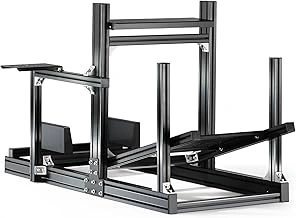
Anman GT/F1 Sim Racing Cockpit 8040 Aluminium Profile Racing Stand
When you invest in a high-torque wheelbase like the Simucube 2 Pro, the cockpit supporting it matters just as much as the wheel itself. The Anman GT/F1 Sim Racing Cockpit uses 8040 aluminium profile construction, a structure designed to handle the forces from direct drive systems without flexing or rattling during aggressive inputs. Priced at $399.99, it offers a stable platform for wheelbases that generate multiple Nm or more, keeping the entire rig solid when you're fighting oversteer or hammering kerbs.
The aluminium profile design allows for adjustment across seat position, wheel height, and pedal angle, so you can dial in the ergonomics that let you stay comfortable during longer sessions. This matters when fine-tuning FFB settings on the Simucube 2 Pro - small changes in seating position or wheel distance can affect how clearly you feel road texture and weight transfer through the rim. The cockpit's modular layout also accommodates different wheel diameters and button box placements, which is useful given the open-platform flexibility of Simucube's USB ecosystem.
Because the Simucube 2 Pro requires a separate wheel purchase, you'll want a cockpit that supports a range of mounting patterns and doesn't dictate a single wheel style. The Anman's adjustable wheel deck and reinforced upright give you that freedom, whether you're running a the listed size round rim for GT work or a wider formula-style wheel for open-wheel racing. Stability under load is the key tradeoff here - aluminium profile rigs like this one resist torsional flex better than steel tube designs, but they require more careful assembly and occasional re-tensioning of bolts as the structure settles in.
If you're pairing a Simucube 2 Pro with a cockpit for the first time, budget for a rig that won't become the weak link in your setup. The Anman GT/F1 sits in the mid-range price tier and delivers the rigidity needed to translate high-fidelity force feedback into your hands, not into frame wobble.
- ✅ 8040 aluminium profile construction resists flex under high-torque direct drive forces
- ✅ Adjustable wheel deck and seat position accommodate different rim sizes and seating preferences
- ✅ Modular layout supports open-platform wheelbases and third-party components
- ✅ Mid-range price point balances rigidity with accessibility for serious sim racers
- ⚠️ Requires careful assembly and periodic bolt re-tensioning as the frame settles
- ⚠️ Aluminium profile rigs demand more setup time than pre-welded steel tube designs
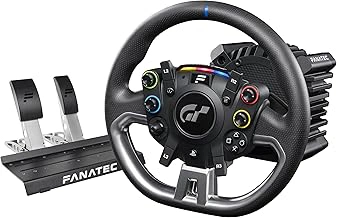
Fanatec Officially Licensed Gran Turismo DD Pro PlayStation Sim Racing Steering Wheel, Base and Pedals – Polyphony Digital Wheel, 5 Nm FluxBarrier Direct Drive, 2-Pedal Set for PC, PS5, PS4
The Fanatec Gran Turismo DD Pro bundle offers a complete entry into direct drive sim racing at $799.99, combining a 5 Nm FluxBarrier wheelbase, the officially licensed GT wheel, and a 2-pedal set in one package. This platform demonstrates Fanatec's turnkey approach: out of the box, the system connects to PC, PS5, or PS4 with minimal configuration, and the included wheel rim attaches via Fanatec's proprietary quick-release system.
Setup simplicity stands out. The Fanatec ecosystem uses plug-and-play firmware updates through the FanaLab software, and the wheelbase auto-detects connected rims and pedals without manual driver tweaking. For users moving up from console controllers or entry-level belt-driven wheels, this reduces the research burden considerably. The included GT wheel features dual-clutch paddles and a rotary encoder, plus PlayStation button integration that works natively in Gran Turismo 7 and other console titles.
Force feedback tuning happens through on-wheel dials and the FanaLab interface, which organizes presets by game title rather than exposing raw motor parameters. This guided approach makes it easier to find a usable baseline quickly, though advanced users may find the abstraction limiting compared to the granular control available in Simucube's TrueDrive software. The 5 Nm torque ceiling in this DD Pro model is adequate for most racing scenarios but sits well below the multiple Nm peak of the Podium DD2 or Simucube 2 Pro's output range.
The broader Fanatec ClubSport catalog provides dozens of compatible wheel rims, shifters, and handbrakes that connect through the same proprietary quick-release and RJ12 data ports. This integration keeps cable clutter low and ensures all accessories appear in the driver software automatically. However, the proprietary QR and electrical interface mean you're locked into Fanatec peripherals; third-party rims require adapters that bypass the data connection, losing button functionality.
Customer support operates through Fanatec's direct sales model and a network of regional service centers, which streamlines warranty claims and firmware troubleshooting compared to reseller channels. The 4.6/5 rating reflects general satisfaction with build quality and console compatibility, though some users note longer lead times for replacement parts and occasional firmware rollout delays.
Long-term cost becomes a factor when upgrading within the ecosystem. Adding a higher-torque Podium wheelbase, load-cell pedal set, or multiple rim options can exceed the price of an open-platform alternative, especially if you eventually outgrow the PlayStation compatibility requirement. The GT DD Pro bundle serves best as a streamlined starting point for console-first racers or PC users who value integrated software and immediate compatibility over deep tuning access and third-party hardware flexibility.
- ✅ Complete bundle with wheelbase, wheel, and pedals at $799.99
- ✅ Native PlayStation 5, PS4, and PC compatibility with plug-and-play setup
- ✅ Proprietary quick-release and data ports reduce cable clutter
- ✅ FanaLab presets simplify initial force feedback tuning
- ✅ Broad ClubSport accessory ecosystem with automatic detection
- ⚠️ 5 Nm torque output lower than high-end Podium or Simucube models
- ⚠️ Proprietary interfaces lock users into Fanatec peripherals
- ⚠️ Less granular force feedback control compared to open-platform software
- ⚠️ Ecosystem upgrade costs accumulate when adding rims and load-cell pedals
- ⚠️ Regional service network may have longer parts lead times
At a Glance: Key Specifications Side-by-Side
Direct drive wheelbases are defined by their core specifications, and the Simucube 2 Pro and Fanatec Podium DD2 sit at different points on the performance and design spectrum. Understanding the raw numbers helps set expectations before you evaluate force feedback character or software.
The Simucube 2 Pro delivers 25 Nm of peak torque through a large-diameter servo motor. It connects to your PC via standard USB, supports firmware updates through Simucube's True Drive software, and weighs approximately 8.4 kg. The housing measures roughly 160 mm wide by 160 mm deep, and street pricing typically lands around $1,399 USD for the wheelbase alone. Because Simucube uses an open USB HID protocol, it works with any third-party steering wheel that includes its own USB connection or button box.
The Fanatec Podium DD2 offers 25 Nm of peak torque as well, using Fanatec's own direct drive motor design. It relies on a proprietary quick-release system and communicates through Fanatec's driver package rather than generic USB input. Firmware updates arrive via the Fanatec Control Panel software. The DD2 weighs around 7.5 kg and occupies a similar footprint. Pricing for the DD2 wheelbase sits near $1,499 USD, though that figure fluctuates with regional availability and bundle promotions. The key trade-off here is ecosystem lock-in: the DD2 requires Fanatec steering wheels or third-party adapters to function.
Both units demand robust mounting solutions due to their weight and torque output. Neither includes a steering wheel, pedals, or quick-release hardware in the base package, so budget for a complete rig accordingly. The motor architectures differ in tuning philosophy, but on paper the torque ceiling is identical.
Build Quality and Industrial Design
Both the Simucube 2 Pro and Fanatec Podium DD2 feature metal housings, but their approaches to industrial design reflect different priorities. The Simucube 2 Pro uses a machined aluminum enclosure with exposed mounting points and a utilitarian aesthetic that emphasizes serviceability. The motor shaft is solid steel, designed for rigidity under high-torque loads, and the quick-release mounting interface is built from aircraft-grade aluminum. Cooling is handled by passive heatsinks combined with a temperature-controlled internal fan that ramps up under sustained load. All connectors are industrial-grade: aviation-style plugs for power and USB Type-B for data, both designed to resist vibration and repeated connection cycles.
The Fanatec Podium DD2 takes a more integrated approach, with a powder-coated steel housing that includes aesthetic accents and branding. The motor shaft is similarly rigid, but the overall design is more consumer-facing, with cable management features and a cleaner profile that suits desk or rig mounting without additional covers. Cooling relies on internal fans that run quieter at idle but can become audible during extended high-FFB sessions. Fanatec uses proprietary connectors for its ecosystem - power, data, and steering wheel attachment all follow Fanatec's standards, which streamlines setup within the Podium family but limits cross-compatibility with third-party hardware.
Connector quality on both units is high, but Simucube's open-platform design allows direct attachment of third-party wheels via standard USB or wireless modules, while Fanatec requires its own steering wheels or third-party adapters that may add complexity. The Simucube quick-release system is a standardized 70 mm pattern compatible with aftermarket options from multiple manufacturers. Fanatec's ClubSport Quick Release system is proprietary and integrates data and power pass-through for its wheels, which simplifies single-brand builds but can complicate mixing ecosystems.
Long-term serviceability favors Simucube. Granite Devices publishes detailed technical documentation, and replacement parts - bearings, cooling fans, connectors - are available directly or through industrial suppliers. The open design allows experienced users to perform maintenance without voiding warranties in most cases. Fanatec's integrated design is less user-serviceable; repairs typically require returning the unit or ordering replacement modules through official channels, and some components are only available as complete assemblies. Both manufacturers offer warranties, but Simucube's modular construction and transparent parts availability give it an edge for users planning decade-long ownership or operating in regions with slower support turnaround.
Force Feedback Deep Dive: Power, Detail, and Fidelity
The Simucube 2 Pro delivers 25 Nm of torque, while the Fanatec Podium DD2 reaches 25 Nm as well, placing both units at the top end of consumer direct drive capability. Raw torque ceiling matters less than how each system translates game telemetry into steering feel. The Simucube 2 Pro uses a large-diameter servo motor with IONI Pro drive electronics, producing a wide dynamic range that preserves subtle detail even at high force levels. The Podium DD2 pairs a smaller outrunner motor with Fanatec's custom controller board, optimized for low latency and tight integration with the Fanatec ecosystem.
Signal granularity becomes noticeable in titles that stream high-frequency FFB data. In iRacing, the Simucube 2 Pro renders fine-grained track texture and kerb vibration with minimal filtering, allowing you to feel small changes in grip as tires load and unload. The Podium DD2 delivers a cleaner, slightly more processed signal that emphasizes major forces - understeer push, oversteer snap, and suspension compression - while smoothing out minor road noise. Neither approach is objectively better; the Simucube favors maximum information density, while the Fanatec prioritizes clarity and reduced wheel chatter.
In Assetto Corsa Competizione, both bases handle the simulation's aggressive FFB peaks without clipping, but the experience differs. The Simucube 2 Pro's higher inertia and longer signal path can feel slightly heavier on initial turn-in, requiring careful tuning of reconstruction filter and damping settings in TrueDrive software. The Podium DD2 responds faster to steering input reversals, partly due to lower moving mass and partly due to Fanatec's tuning priorities. In rFactor 2, where FFB includes tire-slip and road-surface detail, the Simucube's broader frequency response captures more nuance, while the Podium's filtering reduces wheel oscillation during low-speed corners.
Latency measurements are difficult to verify without specialized equipment, but subjective responsiveness in fast chicanes and countersteering situations shows no meaningful gap between the two. The Simucube 2 Pro's signal processing is handled entirely within the base's IONI controller, with no USB buffering delays, while the Podium DD2's electronics are designed to minimize round-trip time between game, driver, and motor. Both systems allow you to adjust damping, friction, and inertia to taste, though the Simucube offers deeper control over reconstruction filters and torque bandwidth modes.
Filtering philosophy separates the two platforms more than hardware capability. Simucube's default profiles preserve high-frequency content, which some users find too noisy and others consider essential realism. Fanatec's Tuning Menu includes a Natural Damper setting that applies velocity-dependent smoothing, reducing oscillation without dulling transient forces. If you prefer unfiltered telemetry and plan to tune every parameter, the Simucube 2 Pro provides more granular control. If you want strong default profiles and faster setup, the Podium DD2's integrated filtering and lower maintenance overhead may suit your workflow better.
Neither base clips or distorts FFB signals under normal use, and both handle sustained high-torque scenarios without thermal throttling during typical race sessions. The Simucube 2 Pro's larger motor runs cooler under continuous load, while the Podium DD2's forced-air cooling keeps temperatures stable during endurance events. In practice, both deliver torque headroom well beyond what most users will run comfortably, making tuning precision and signal fidelity the deciding factors rather than peak power alone.
Software, Tuning, and User Experience
Software preferences often matter as much as hardware when choosing between these two wheelbases. Simucube's True Drive suite gives you direct access to dozens of force feedback filters, reconstruction settings, and per-profile adjustments that let you dial in slip angle feel, damping, and inertia with precision that enthusiasts appreciate. The interface is clean but assumes you understand what slew rate limiting and torque bandwidth reconstruction actually do. If you enjoy experimenting with tuning files shared by the community or building profiles from scratch for each sim title, True Drive rewards that effort with feedback fidelity that feels closer to the raw output of the motor.
Fanatec's driver package takes a different approach. The tuning menu lives partly on the wheelbase's OLED display and partly in the Windows control panel, with fewer exposed parameters and more reliance on pre-set modes labeled Drift, Linear, or Peak. Updates arrive through the Fanatec software portal, and firmware stability has improved significantly over the past year, though some users still report occasional driver conflicts when swapping wheels or pedals in the ecosystem. The streamlined setup gets you racing faster, but if you want to chase a specific steering weight curve or adjust individual filter bands, you'll hit the ceiling sooner than with Simucube.
Learning curve is steeper on the Simucube side. Expect to spend an evening reading forum guides and testing small changes to understand which sliders affect what you feel through a corner. Fanatec's out-of-box experience is more plug-and-play, especially if you stay within the Fanatec ecosystem where auto-detection handles most configuration. For sim racers who value granular control and don't mind the research, Simucube's software depth is a feature; for those who want strong feedback without becoming a tuning specialist, Fanatec's simplified interface makes more sense.
Ecosystem Compatibility: Wheels, Pedals, and Accessories
Ecosystem compatibility shapes long-term cost and upgrade flexibility in ways that often matter more than the wheelbase itself. Fanatec builds a tightly integrated system around the Podium DD2, using a proprietary Quick Release mechanism that locks you into ClubSport and Podium steering wheels. Fanatec wheels connect directly to the base, drawing power and transmitting button inputs through the wheelbase without separate USB cables. This clean setup simplifies cable management and delivers a polished, console-like experience, but it also means every wheel purchase flows back to Fanatec. The QR1 and QR2 systems are not cross-compatible with standard aftermarket wheels unless you add adapters, and those adapters often sacrifice the plug-and-play button integration that makes the Fanatec ecosystem appealing in the first place.
Simucube takes the opposite approach. The 2 Pro uses a generic 70 mm bolt pattern and relies on an external USB hub for button inputs, opening the door to any aftermarket wheel from manufacturers like Cube Controls, Ascher Racing, or custom builders. You supply your own quick release - many users choose D1-Spec or NRG units - and wire button boxes through USB. This freedom comes with trade-offs: more cables to manage, no single-vendor support, and the responsibility to match torque ratings and ensure electrical compatibility. For experienced sim racers who want specific rim shapes, custom button layouts, or high-end carbon fiber wheels, Simucube's universal design is a major advantage. For users who value simplicity and a curated product line, Fanatec's closed loop is easier to navigate.
Pedals and shifters follow the same pattern. Fanatec's ClubSport V3 pedals and sequential shifters connect via RJ12 to the wheelbase, consolidating USB ports and reducing desktop clutter. Simucube requires pedals to connect independently via USB or through a separate button box interface. Most high-end pedal sets - Heusinkveld, Asetek, or VRS - use USB anyway, so the difference matters less at this tier, but it does mean Simucube setups occupy more USB bandwidth and require careful hub management. Shifters and handbrakes work the same way: Fanatec peripherals plug into the base, while Simucube users connect third-party hardware directly to the PC.
The cost implications run deeper than the initial purchase. Staying inside the Fanatec ecosystem means predictable compatibility and streamlined firmware updates, but you pay Fanatec's retail pricing for every component. Leaving the ecosystem - swapping a Fanatec wheel for a third-party rim on the DD2 - requires adapters that add cost and complexity without full feature parity. Simucube's openness means you can mix budget button boxes with premium pedals, but you shoulder the integration work and troubleshooting when USB devices conflict or firmware updates disrupt a multi-vendor rig. If you plan to upgrade incrementally and want the widest range of hardware choices, Simucube's flexibility pays off. If you prefer a single vendor relationship and value integrated support, Fanatec's walled garden makes more sense.
Cockpit and Mounting Requirements
Both the Simucube 2 Pro and Fanatec Podium DD2 deliver peak forces that exceed 17 Nm and 25 Nm respectively, which means your cockpit must absorb sustained torque without flexing. A desk clamp or folding rig will telegraph every high-force corner into unwanted movement, masking the fine detail these wheelbases are designed to communicate and leaving your arms fighting the rig rather than the car.
An 8040 aluminum profile cockpit - or steel tubing with comparable torsional rigidity - anchors the wheelbase securely enough that force feedback translates directly to your hands. When the chassis flexes, you lose the crisp onset of understeer and the subtle weight shift cues that separate fast laps from guesswork. Flex also increases fatigue because you spend energy stabilizing the whole assembly instead of making precise steering corrections.
Both wheelbases ship with mounting patterns compatible with most 8040 rigs, but verify hole spacing before ordering if your cockpit uses a proprietary plate. The DD2's integrated quick-release adds front-to-back weight, so check that your wheel deck offers enough fore-aft adjustment to position the rim comfortably without bottoming out the slider. The Simucube 2 Pro's more compact servo leaves slightly more room for monitor stand brackets if your cockpit shares vertical space.
If you plan to upgrade from a belt-driven system, budget for cockpit reinforcement at the same time. Running either wheelbase on anything less rigid wastes the hardware investment and turns extended sessions into an endurance test for your shoulders and wrists.
Price and Overall Value Proposition
Calculating the real cost of either system starts with the wheelbase, but that number tells only part of the story. The Simucube 2 Pro typically retails around $1,400 for the wheelbase alone, while the Fanatec Podium DD2 comes in near $1,500. Those figures shift when you add a steering wheel: Fanatec offers several rim options in the $400 - $1,000 range that attach directly to its Quick Release system, whereas Simucube wheelbases use an open 70 mm bolt pattern that accepts third-party rims from manufacturers like Cube Controls, Ascher Racing, and SimRacingBay, with prices ranging from $300 to well over $2,000 depending on features and build quality.
Pedals and a cockpit push the total even higher. Both systems demand a sturdy rig capable of handling 25 Nm of torque without flex, which usually means an aluminum profile cockpit in the $500 - $1,200 range. Pedals suitable for this level of hardware - load-cell brake sets from Heusinkveld, Simtag, or Fanatec's own Clubsport V3 line - add another $400 - $1,000. By the time you assemble a complete setup, you're looking at $3,000 to $5,000 or more, depending on peripheral choices.
Resale value leans slightly in favor of Simucube hardware. The open ecosystem and strong enthusiast community mean used Simucube wheelbases hold their value well, often selling for 70 - 80 percent of retail even after a year of use. Fanatec gear also resells reasonably, but the closed ecosystem and periodic new product launches can compress secondary market prices faster. Upgrade path economics differ too: Simucube users can swap wheels without replacing electronics or quick-release hardware across brands, while Fanatec upgrades typically stay within the Podium ecosystem unless you add adapters.
Five-year cost of ownership hinges on how often you tinker. If you plan to experiment with different rim styles, button boxes, or control layouts, the Simucube's compatibility with third-party hardware can save money over time. If you prefer a curated product line with matched aesthetics and plug-and-play setup, Fanatec's integrated ecosystem reduces compatibility guesswork but may cost more if you want to step outside the brand. Value ultimately aligns with your technical comfort level, willingness to research components, and whether you prioritize flexibility or convenience in your racing setup.
The Final Verdict: Which Wheelbase is Right for You?
Both the Simucube 2 Pro and Fanatec Podium DD2 represent the peak of consumer direct drive technology, yet they serve different types of sim racers. The Simucube 2 Pro appeals to users who want granular control over every aspect of force feedback behavior and who plan to pair their wheelbase with third-party hardware from multiple manufacturers. Its open architecture and deep tuning options reward patience and technical curiosity, making it ideal for those building a best-in-class setup from individually selected components.
The Fanatec DD2 fits users who prioritize streamlined integration, unified software, and vendor support across their entire sim racing ecosystem. If you already own Fanatec pedals, shifters, or button boxes - or plan to expand within that family - the DD2 delivers plug-and-play convenience that saves hours of configuration. The tradeoff is less freedom to mix brands and fewer low-level tuning parameters compared to the Simucube platform.
Neither wheelbase is objectively superior. The Simucube 2 Pro offers finer detail and more flexibility for those willing to invest the time. The Fanatec DD2 offers smoother onboarding and tighter ecosystem cohesion for users who value simplicity and long-term support. Your decision should hinge on whether you prioritize tuning depth or turnkey integration, and whether your broader hardware strategy leans toward open compatibility or a single-vendor ecosystem.
Consider how each wheelbase fits your existing gear and future upgrade path. If you're building around universal components and want maximum control, the Simucube 2 Pro is the logical choice. If you prefer a cohesive platform with consistent firmware updates and customer service, the Fanatec DD2 delivers that experience. Both will serve dedicated sim racers well - the right pick depends on your workflow, patience for tuning, and long-term hardware vision.
Decision Framework: Which Wheelbase Fits Your Priorities?
- Choose Simucube 2 Pro if you value open-platform flexibility, maximum FFB fidelity, and plan to swap peripherals across manufacturers.
- Choose Fanatec DD2 if you prefer a streamlined ecosystem, faster setup, and want a known upgrade path within one product family.
- Both require a rigid 8040 aluminum cockpit; do not compromise on chassis stiffness at this torque level.
- Budget for wheel, pedals, and cockpit separately; wheelbase alone does not complete the system.
- Consider resale value and local community support when calculating long-term ownership cost.