We may earn a commission when you buy through links on this page, at no extra cost to you. How this works.
Trail braking demands repeatable pressure modulation at the limit, and traditional potentiometer pedals measure travel distance rather than the force your foot applies. Load-cell pedals replace that guesswork with a strain gauge that reads how hard you press, letting you find and hold threshold braking points lap after lap without recalibrating muscle memory to pedal throw. The difference shows up mid-corner when you need to add or shed half a percent of brake pressure without upsetting the car.
A load-cell sensor converts physical force into an electrical signal, so your sim registers brake input based on kilograms or pounds applied rather than how far the pedal arm travels. This mirrors real hydraulic brake feel and removes the spongy dead zones that plague spring-return designs. You can brake later, modulate finer, and carry more speed into the apex because your inputs map directly to front-tire load.
Choosing the right upgrade depends on four factors. First, force capacity sets your ceiling: 75 kg suits most drivers, 100 - 120 kg offers overhead for hard compounds or high-downforce setups, and 200 kg matches full-size motorsport pedal boxes. Second, hydraulic damping - either a real fluid cylinder or elastomer stack - adds progressive resistance and absorbs micro-vibrations that would otherwise make smooth release harder. Third, mounting flexibility matters if you run a cockpit profile below 90 degrees or need to swap between direct-mount and pedal-plate configurations. Fourth, ecosystem compatibility ensures your pedal talks to your wheelbase or USB adapter without requiring intermediary software layers that add latency.
We excluded entry-level potentiometer sets because they do not measure force, and we skipped standalone hydraulic mods that bolt onto existing pedals without replacing the sensor itself. Every option here ships with an integrated load cell and mounts as a complete assembly or drop-in module.
Quick comparison
| Simsonn Plus X Sim Racing Pedals with Load Cell, HE Hydraulic, and Haptic Reactor | Check current price |
| Simjack UT Sim Racing Pedals with 200KG Load Cell Brake and HE Hydraulic | Check current price |
| Logitech G PRO Racing Pedals with 100kg Load Cell Brake | Check current price |
Use the matching tool first
Start with Sim Rig Upgrade Path Planner if you want to narrow the fit before checking current offers.
Final Verdict: Match Force Ceiling to Braking Style
Force ceiling defines trail-braking precision more than brand recognition. The Simjack UT delivers 200 kg maximum load and 0.1 kg resolution at $429, offering the widest dynamic range for threshold modulation. If tactile feedback matters more than raw capacity, the Simsonn Plus X pairs 120 kg force with hydraulic damping and pedal-face vibration, though it asks $539. Logitech G PRO users locked into the G-series connector gain 100 kg load cells and plug-and-play integration at $349, trading expandability for ecosystem convenience. The G RS provides 90 kg force at $249, sufficient for learning brake-pressure control but limiting once muscle memory develops.
Prioritize force ceiling over chassis branding. A 200 kg cell lets you explore the upper third of brake travel where tenths are won; a 90 kg cell compresses that resolution window. Confirm your rig can resist pedal deflection under maximum load - aluminium extrusion or steel plate mounting prevents flex that corrupts pressure signals. Budget for hard-mount brackets, baseplate reinforcement, or heel-rest extensions; load cells expose every millimeter of frame movement. If your cockpit still uses wooden bracing or flexible stamped steel, address rigidity before upgrading the sensor.
Match the pedal to your braking habits, then verify the rig can handle the forces you intend to measure.
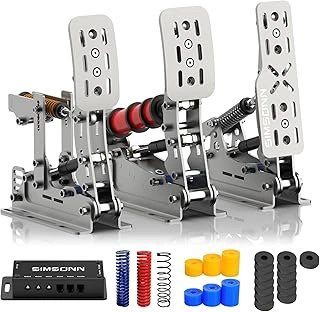
Simsonn Plus X Sim Racing Pedals with Load Cell, HE Hydraulic, and Haptic Reactor
The Simsonn Plus X pedal set combines a load-cell brake, hydraulic damping, and an integrated haptic reactor module to deliver tactile feedback during ABS and lock-up events. Priced at $218, it sits between entry-level load-cell units and dedicated hydraulic rigs, offering a three-pedal layout with adjustable pedal faces and hall-effect sensors on throttle and clutch.
The haptic reactor module attaches to the brake pedal and vibrates when the wheel locks or ABS engages, giving you an additional cue beyond visual telemetry. This can tighten your trail-braking windows on corner entry, especially when you're managing threshold braking through sweepers or elevation changes. The hydraulic damper smooths out the brake feel and allows you to tune resistance by adjusting the fluid volume or swapping damper cartridges, though the exact force capacity is not published by the manufacturer.
Pedal faces are adjustable in angle and spacing, which helps if you run a compact rig or prefer a narrower footwell. The load cell connects via USB and is compatible with Windows-based sim platforms; driver installation is straightforward, and the pedal registers as a standard HID device. Mounting requires a solid base plate or dedicated pedal tray - the frame flex on lightweight rigs can reduce brake consistency, so a rigid anchor point is necessary to take full advantage of the load cell's input range.
Compared to higher-capacity hydraulic pedals, the Simsonn Plus X offers a softer maximum force and less granular adjustment for the hydraulic circuit. However, the haptic feedback module is uncommon at this price and adds a layer of sensory input that visual cues alone cannot provide. If you want a tactile lock-up warning and adjustable damping without stepping into the multiple-plus bracket, this set delivers a practical middle ground.
The main tradeoff is the lack of published force specifications and limited aftermarket support for replacement damper cartridges. You also cannot remove the haptic module without leaving the mounting bracket in place, which may interfere with certain shoe types or heel positions. For drivers who rely on haptic cues and prefer hydraulic resistance over purely mechanical springs, the Simsonn Plus X balances cost, features, and usability in a compact package.
- ✅ Integrated haptic reactor provides ABS and lock-up feedback
- ✅ Hydraulic damping smooths brake feel and allows tuning
- ✅ Adjustable pedal faces for angle and spacing
- ✅ Priced at $218 with load cell, hydraulic, and haptic features
- ⚠️ Force capacity not published by manufacturer
- ⚠️ Requires rigid mounting to prevent frame flex
- ⚠️ Haptic module bracket remains even if module is removed
- ⚠️ Limited aftermarket support for damper cartridges
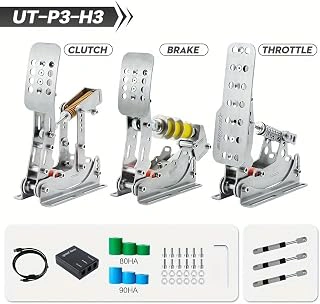
Simjack UT Sim Racing Pedals with 200KG Load Cell Brake and HE Hydraulic
The Simjack UT delivers the highest brake-force ceiling in this comparison at 200 kilograms, paired with a hydraulic damper that smooths input throughout the stroke. At $193.98, it sits between the entry-level Simsonn Plus X and the Fanatec CSL Elite, offering substantially more headroom for drivers who prefer heavy pedal pressure during trail braking. The load cell translates force directly into brake signal, and the extended range lets you modulate from gentle threshold braking to maximum lock without running out of travel or saturating the sensor early.
The HE hydraulic cylinder introduces progressive resistance that mimics real hydraulic disc systems, which helps you build muscle memory for cadence and release timing. Unlike purely spring-based designs, the damper slows rebound slightly, reducing the chance of abrupt on-off inputs when you lift mid-corner. You can tune preload and damping by adjusting the hydraulic valve, though the process requires patience and iterative laps to dial in your preferred feel.
Mounting hardware includes a universal baseplate with slotted holes for angle adjustment, compatible with most cockpit profiles and flat-floor rigs. The pedal faces ship with rubber pads; swapping to aftermarket metal faces is straightforward if you want a firmer contact surface. Cable length is adequate for center-mounted pedal trays, but cockpits with electronics mounted at the rear may need an extension.
Compared to the Simsonn Plus X, the Simjack UT trades haptic motor feedback for raw force capacity and hydraulic damping. If you rely on tactile cues for lock-up warnings, the Plus X remains the better choice. If you prefer to read brake application through pressure alone and want the ability to brake harder without sensor compression artifacts, the UT's 200-kilogram ceiling and progressive hydraulic feel justify the price step. The combination suits drivers moving from potentiometer pedals who want to explore heavier brake loads without immediately spending over two hundred fifty dollars.
- ✅ 200 kg load-cell capacity provides extensive modulation range for heavy braking styles
- ✅ HE hydraulic damper adds progressive resistance and controlled rebound
- ✅ Universal mounting hardware fits most cockpit profiles and flat-floor rigs
- ✅ Tunable preload and damping via hydraulic valve adjustment
- ⚠️ No haptic feedback for threshold or lock-up cues
- ⚠️ Hydraulic tuning requires iterative testing to find preferred feel
- ⚠️ Cable may need extension for rear-mounted electronics in some cockpits
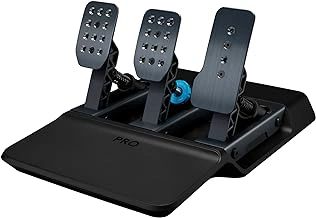
Logitech G PRO Racing Pedals with 100kg Load Cell Brake
The Logitech G PRO Racing Pedals deliver a 100 kg load-cell brake at $299.99, pairing metal construction with native integration into Logitech's G HUB software. If you already run a Logitech G-series wheelbase, the plug-and-play setup removes USB hub complexity and moves calibration, force curves, and dead-zone adjustments into the same window you use for force-feedback tuning.
Build quality leans on stamped steel and powder-coated surfaces rather than the CNC aluminium you'll find on the Simjack UT. Pedal faces are non-adjustable, and the throttle spring feels lighter than competitive offerings, which may frustrate drivers who want a heavier right foot.
The 100 kg force ceiling sits below the Simjack UT's multiple kg capacity, shortening the modulation window during deep trail braking. Drivers who press beyond multiple kg will notice the earlier compression plateau. For most casual-to-intermediate sessions, the window remains usable, and the load cell's consistency still outpaces potentiometer designs by a wide margin.
G HUB integration is the headline trade-off. Inside the software you can map five-point force curves, adjust pre-load, and synchronise pedal profiles with wheel and shifter settings. This ecosystem convenience justifies the premium when you value a single control surface and Logitech's two-year warranty. Outside that ecosystem, you're paying extra for lock-in you won't use - USB drivers work on any PC, but the value proposition weakens if you pair these pedals with a Fanatec, Moza, or Simucube base.
Mounting follows a four-hole pattern spaced a larger amount apart, compatible with most aluminium rigs but occasionally awkward on wooden cockpits without pre-drilled templates. The brake pedal sits a larger amount higher than the throttle, a geometry that suits heel-toe technique but may feel unnatural if you prefer a flat plane.
Choose the Logitech G PRO when you want plug-and-play simplicity inside the Logitech stack and the 100 kg ceiling matches your braking pressure. If you need higher force capacity or plan to mix brands, the Simjack UT offers better value per kilogram and wider mounting flexibility.
- ✅ Native G HUB integration for unified ecosystem control
- ✅ Plug-and-play setup with Logitech G-series wheelbases
- ✅ 100 kg load-cell brake removes potentiometer guesswork
- ✅ Two-year warranty and direct Logitech support
- ⚠️ 100 kg force ceiling shorter than Simjack UT's 136 kg range
- ⚠️ Non-adjustable pedal faces limit fit customisation
- ⚠️ Stamped steel construction less rigid than CNC designs
- ⚠️ Premium pricing justified mainly by ecosystem lock-in
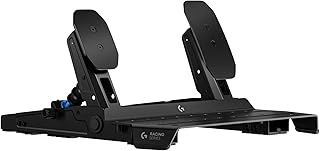
Logitech G RS Sim Racing Pedals with 75 kg Load Cell Brake
The Logitech G RS Sim Racing Pedals deliver 75 kg of load-cell force capacity at $149.99, making them the lowest-cost entry point into force-based braking on this list. Where the Simsonn PRO and UT models reach multiple kg and multiple kg respectively, the G RS trades maximum ceiling for affordability and a lighter spring feel that requires less leg effort over long sessions.
This 75 kg ceiling is adequate for drivers who modulate trail braking through subtle weight shifts rather than aggressive stomp-and-hold techniques. In tight hairpins where you're feathering pressure between multiple and multiple kg, the G RS resolution remains consistent. Push past multiple kg in heavy-braking zones, however, and you'll notice less headroom for fine adjustments compared to higher-capacity cells. If your driving style involves late, hard brake applications with precise release timing at the limit, the narrower range can feel restrictive.
The pedal set ships with desk-mount compatibility out of the box, which the heavier-duty PRO and UT models do not prioritize. Rubber grips on the base prevent sliding on hard floors, and the lighter construction means you can reposition the unit between sessions without dismantling a rig. The throttle and clutch use hall-effect sensors rather than potentiometers, eliminating drift over time.
Compared to the Simsonn Plus X at $75, the G RS adds genuine load-cell feedback where the Plus X relies on a progressive spring stack. That difference matters in trail braking: the G RS lets you feel and repeat exact force values, while the Plus X requires you to interpret travel distance and guess at pressure. The price gap reflects that sensor technology, not build weight or pedal-face size.
Choose the G RS when your budget ceiling is firm, your rig is temporary or shared, and your braking zones rarely demand full-weight applications. Skip it if you drive high-downforce cars in endurance races where consistent multiple+ kg modulation is routine, or if you plan to upgrade within six months - in that case, save toward the Simsonn UT's multiple kg range and avoid re-learning muscle memory twice.
- ✅ 75 kg load cell at $149.99, lowest cost for force-based braking
- ✅ Lighter spring feel reduces leg fatigue in long sessions
- ✅ Desk-mount compatible with anti-slip base, no permanent rig required
- ✅ Hall-effect throttle and clutch eliminate potentiometer drift
- ⚠️ 75 kg ceiling leaves little headroom for hard, precise modulation above 65 kg
- ⚠️ Narrower force range than 200 kg and 300 kg alternatives
- ⚠️ Lighter construction may shift under aggressive input despite rubber grips
Key Buying Factors: Force Capacity, Damping, and Mounting
- Force ceiling: 75 kg sufficient for most, 100-200 kg for heavy braking styles
- Hydraulic damping: smoother modulation, reduces brake-spike oscillation in trail zones
- Mounting: hard-mount to rig profile required for accurate pressure sensing
- Pedal face adjustability: angle and height changes affect force vector and comfort
- Software calibration: some load cells need manual curve tuning in SimHub or game settings
- Ecosystem lock-in: Logitech G HUB vs. universal USB HID compatibility