We may earn a commission when you buy through links on this page, at no extra cost to you. How this works.
Force feedback through your steering wheel captures the subtle weight shifts and road texture of every corner, but the moment you stomp the brake pedal, your body feels nothing. Real drivers experience chest pressure, weight transfer, and deceleration forces that telegraph braking performance long before visual cues arrive. Sim racers chasing that missing layer of immersion face two distinct paths: active belt tensioner systems that pull harnesses tight to simulate forward load during braking, and this product bass shakers that vibrate the rig to create haptic feedback tied to telemetry.
These technologies approach the same problem from opposite directions. Active belt tensioners apply physical pressure directly to your torso, mimicking the chest compression you'd feel in a real car when braking hard into a corner. this product shakers use low-frequency vibration to transmit braking intensity, tire lock-up, and road feel through your seat and pedals, relying on your body's sensitivity to motion rather than direct force.
This comparison focuses specifically on braking G-force feedback, not the full spectrum of haptic effects each system can deliver. The evaluation rests on five criteria: how convincingly each technology replicates the sensation of deceleration, total cost including mounting hardware and necessary cockpit upgrades, structural and spatial demands your rig must meet, installation complexity and software tuning requirements, and any secondary haptic benefits that extend beyond braking alone.
Understanding these tradeoffs requires looking past marketing promises and examining what each system physically does to your body, how much infrastructure it demands, and whether the sensation it produces aligns with the braking cues your brain expects.
Quick comparison
| Adjustable 10 Lbs Belt Tension Gauge for Motorcycle & Bicycle Drive Belts, Yellow | Check current price |
| MOZA R12 V2 Direct Drive Sim Racing Wheelbase Servo Base | Check current price |
How Bass Shakers Work: Translating Sound into Vibration
this product and similar bass shakers function as low-frequency transducers that convert audio signals into mechanical vibration. The system starts with telemetry data from your sim racing software - information about vehicle speed, engine RPM, suspension load, and braking force. Software like SimHub or SimVibe reads this telemetry stream and translates it into specific low-frequency audio channels, each corresponding to a different driving event. This audio signal routes through an amplifier to the shaker unit, which attaches rigidly to your rig and vibrates at frequencies typically between 5 and 200 Hz.
Different frequency ranges correspond to different sensations. Engine rumble usually sits in the 30-80 Hz band, road texture and surface bumps occupy the mid-range, gear shifts produce short bursts around 50-60 Hz, and braking feedback registers as lower-frequency pulses tied to deceleration values reported by the game. The shaker does not measure actual physical force or acceleration - it vibrates in proportion to the telemetry number the software receives. When you brake hard, the sim reports a high deceleration value, the software outputs a stronger bass signal, and the shaker increases vibration intensity.
This indirect method creates a perceptual trade-off. You feel vibration intensity change with braking pressure, but the sensation lacks directional pressure or forward-backward movement. A hard stop produces a strong buzz through the seat or pedal plate rather than the chest-compression or harness-load feeling that real deceleration generates. The vibration can be tuned for frequency, amplitude, and duration, letting you emphasize braking events over engine noise or adjust intensity to match your preference. The result is haptic feedback that adds texture and event awareness without replicating the actual inertial forces of stopping.
How Active Belt Tensioner Systems Work: Simulating G-Force Through Pressure
Active belt tensioner systems recreate braking force by physically pulling your racing harness tight against your chest and shoulders. An electric servo motor or pneumatic actuator connects to your 4-point or 6-point harness straps, tightening them in response to deceleration data sent from your sim racing software. When you hit the brakes hard in the simulation, the actuator pulls the shoulder straps backward, compressing your torso into the seat and replicating the forward inertia you would feel in a real car under heavy braking.
The control software reads telemetry output from your racing sim - deceleration values measured in G-force - and commands the actuator to apply proportional tension. Threshold braking at 2 Gs triggers stronger strap tension than gentle braking at 0.5 Gs, creating a scaled sensation that matches the on-screen action. During trail braking, when deceleration decreases mid-corner, the tension releases gradually. When you accelerate out of a turn, the system fully releases the straps, allowing your body to relax forward slightly and preparing for the next braking event.
This directional accuracy delivers a realistic representation of longitudinal G-forces. The forward pressure during braking mirrors the inertia load drivers experience, and the release cycle during acceleration completes the feedback loop. Because the force vector acts directly on your upper body through the harness, the sensation closely resembles the chest compression and shoulder load present in real motorsport.
The system does require specific hardware and careful setup. You need a properly installed 4-point or 6-point racing harness rather than a standard lap belt, because the tensioner acts on the shoulder straps. The harness must be mounted securely to your cockpit frame with correct angles and spacing, as improper geometry reduces the effectiveness of the tension feedback. Active belt tensioners also add mechanical complexity to your rig, introducing moving parts, control electronics, and wiring that require initial configuration and occasional maintenance. Fit matters: if the harness sits too loose or too tight at rest, the tensioner's working range will be compromised, limiting the realism of the braking sensation.
Head-to-Head Comparison: Braking and Acceleration Feedback
Braking feedback separates these two technologies most clearly. Active belt tensioners create directional chest pressure that scales with deceleration intensity, pulling the harness tight as you brake and loosening as you accelerate. This replicates the forward-and-backward inertia your body experiences in a real car, giving you a physical cue that corresponds to weight transfer. During threshold braking - the zone where you're trying to find maximum grip without locking the wheels - you feel subtle changes in tension that help reinforce pedal input timing.
this product shakers generate vibration correlated to brake force or deceleration data from the sim, but the feedback is non-directional. The entire seat vibrates rather than applying pressure to your chest or shoulders. What you perceive is closer to ABS engagement or the mechanical feedback traveling through the pedal and chassis, not the sensation of your body being thrown forward. Intensity can be mapped to braking strength, but the sensory experience remains a vibration rather than a directional push.
For acceleration, active belt systems release tension, returning to a neutral state or slight slack as the car gains speed. Some users describe this as less dramatic than braking, since the harness can only pull, not push. this product shakers handle acceleration differently: they can simulate engine vibration, transmission response, and wheelspin through frequency modulation. Low-frequency rumble during hard acceleration or wheel slip adds a layer of immersion that belt tensioners don't address.
When braking realism is the priority, active belt tensioners deliver a more accurate physiological cue. The directional force mirrors real-world weight transfer and helps you gauge deceleration without relying solely on visual or audio cues. this product shakers provide broader sensory immersion across multiple driving phases - braking, acceleration, road texture, and mechanical noise - but the feedback is less precise in communicating directional G-forces. If your goal is to improve braking consistency through haptic feedback, the belt tensioner's chest pressure offers a clearer, more actionable signal.
Comparing Other Haptic Effects: Road Texture, Kerbs, and Engine RPM
Beyond braking feedback, haptic systems deliver very different experiences when it comes to road texture, kerb strikes, and engine vibration. this product shakers excel in these areas because they reproduce frequency-based effects across the entire sim racing experience. Gravel rumble, rumble strip impacts, gear shift clunks, engine RPM resonance, and collision jolts all translate naturally through bass transducers, and SimHub makes it simple to tune intensity and frequency response for each effect independently.
Active belt tensioners, by contrast, operate along a single axis - fore and aft - and cannot replicate lateral forces, high-frequency road surface changes, or the multi-directional feedback from kerbs and impacts. The mechanism pulls and releases to simulate acceleration and braking inertia, but it lacks the bandwidth to convey the texture of tarmac transitions or the sharp jolt of a wheel dropping off a kerb edge.
This limitation is why most active belt users also install bass shakers in their rigs. The two technologies complement each other: belts handle the slower, directional weight transfer that mimics G-force onset and release, while shakers fill in the higher-frequency sensations that come from the road and drivetrain. Rather than viewing them as competing solutions, consider them parts of a layered haptic strategy.
If your budget allows only one investment and you value a full spectrum of tactile cues - including engine feel, surface changes, and impact feedback - a quality bass shaker setup will cover far more sensory ground than belts alone. But if braking immersion is your top priority and you plan to expand your haptic toolkit over time, starting with an active belt system and adding shakers later builds a more complete feedback environment than either option can deliver on its own.
Cost and Complexity: Analyzing the Full Investment for Each System
Understanding the financial and installation commitment helps clarify which haptic system fits your budget and technical comfort level. this product shaker setups start with a single transducer unit like the Gamer Plus, typically priced around $200, plus an amplifier that adds another $100 to $150 if not bundled. Mounting hardware - brackets, isolation feet, and fasteners - runs $20 to $40, and software like SimHub is available at no cost. A functional single-shaker configuration usually lands between $300 and $400.
Active belt tensioner systems demand a larger upfront investment. The servo motor unit alone costs $400 to $700, depending on the manufacturer and torque output. A control box with wiring and interface circuitry adds $100 to $200. If your rig does not already have a suitable 4-point or 6-point racing harness, that piece will cost another $150 to $300. Mounting brackets and any necessary cockpit reinforcement to handle servo forces contribute an additional $50 to $100. The complete active belt system typically ranges from $700 to $1,300.
Installation complexity diverges sharply. Mounting a this product involves securing the shaker to your seat base or chassis, routing a power cable, and connecting an audio signal from your PC - most builders finish in one to two hours. Active belt installation requires threading the harness through servo pulleys or spools, positioning the servo with precise alignment to avoid binding, integrating the control box with your sim software, and tuning tension curves and timing offsets. This process often takes four to six hours and may require drilling new mount points or adding structural bracing to your cockpit frame.
Ongoing maintenance for shakers is minimal: periodic checks of mounting bolts and occasional cleaning of the transducer housing. Active belt systems need more attention, including servo bearing inspection, harness webbing wear monitoring, and pulley alignment verification to maintain smooth, consistent tension without premature component fatigue. The higher cost and installation demands of belt tensioners buy a different type of feedback - direct chest pressure - while the simpler, less expensive this product approach delivers vibration across a broader seat area.
Cockpit and Mounting Requirements: What Your Rig Needs
Mounting requirements differ sharply between these two technologies, and understanding your cockpit's capability matters before you buy. this product shakers attach directly to the seat or cockpit frame and rely on that structure to transmit vibration cleanly. The shaker itself weighs four to six pounds, so most aluminum profile rigs and steel tube cockpits handle the load without trouble. The challenge is controlling resonance: thin panels or hollow tubing can rattle or buzz at certain frequencies, so many users add isolation mounts between the shaker and the floor to keep vibration from transferring through the room. The shaker takes up almost no additional space and can be removed in minutes if you need to reconfigure or transport your setup.
Active belt tensioner systems impose stricter structural demands. The servo unit mounts to a rigid vertical profile or rear upright, typically at shoulder height, and the harness must route through the cockpit without interference from seat brackets or electronics. You need a four-point or six-point harness with proper mounting points; lap-only belt configurations are incompatible. The servo generates tension forces that can flex weaker frames, so manufacturers recommend 8020 aluminum extrusion or equivalent-grade construction. Expect the system to add six to ten inches of depth behind the seat, which may require repositioning monitors or rearranging your space. Installation is semi-permanent: once routed and calibrated, the belt tensioner stays in place, and removal means re-threading the harness and recalibrating the servo each time.
Portability favors the this product by a wide margin. Active belt users frequently discover their entry-level cockpit cannot support the system safely and end up upgrading the entire frame before installation, which adds both cost and complexity to the project. If your rig uses thin-wall tubing, folding brackets, or lacks a solid rear structure, budget for cockpit reinforcement or replacement alongside the tensioner itself.
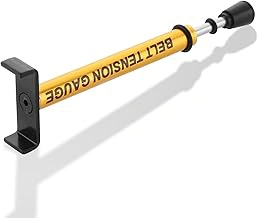
Adjustable 10 Lbs Belt Tension Gauge for Motorcycle & Bicycle Drive Belts, Yellow
Sim racers exploring harness setups often overlook the importance of balanced strap tension. The Adjustable 10 Lbs Belt Tension Gauge is a compact diagnostic tool designed for motorcycle and bicycle drive belts, but it can be repurposed to measure and equalize tension across individual harness straps during initial installation or periodic checks. Priced at $9.99, it offers a low-cost way to confirm that your 4-point or multiple-point harness applies consistent pressure across the shoulders and lap without relying on guesswork.
The gauge reads up to the listed size of tension, which is adequate for identifying imbalances between harness straps and ensuring each anchor point shares the load evenly. This matters for comfort during longer sessions - uneven tension can create pressure points or allow excess slack, reducing the effectiveness of the harness as a reference for braking forces. The tool fits between the strap and the mounting point, allowing you to pull the webbing until the gauge registers the desired reading.
That 10-pound ceiling limits its use in high-load scenarios or with heavier-duty racing harnesses that require significantly higher pretension. It also has no role in active tensioning: this is a static measurement device with no electronics, no integration with sim software, and no ability to apply dynamic feedback. It measures existing tension but does not generate or modulate it in response to telemetry.
For sim racers considering active belt tensioner systems or Adjustable 10 Lbs Belt Tension Gauge for Motorcycle & Bicycle Drive Belts, Yellow shakers, this gauge serves as a setup accessory rather than a haptic solution. Use it to establish a consistent baseline tension when mounting your harness, then rely on active tensioners or tactile transducers to deliver braking feedback during simulation. The gauge is small, straightforward to operate, and inexpensive enough to keep in your toolkit for harness adjustments or troubleshooting fit issues. It does one thing - measure strap tension - and does it without complexity.
- ✅ Inexpensive diagnostic tool for measuring harness strap tension during setup
- ✅ Helps identify and correct imbalances across individual anchor points
- ✅ Compact and simple to use with no learning curve
- ✅ Useful for periodic checks to maintain consistent harness fit
- ⚠️ 10-pound maximum capacity limits use with high-tension racing harnesses
- ⚠️ No active tensioning capability or software integration
- ⚠️ Not a haptic feedback device - measures static tension only
- ⚠️ Designed for motorcycle/bicycle belts, not purpose-built for sim racing harnesses
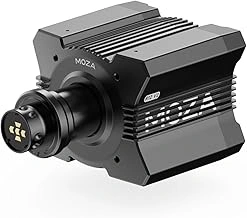
MOZA R12 V2 Direct Drive Sim Racing Wheelbase Servo Base
Both MOZA R12 V2 Direct Drive Sim Racing Wheelbase Servo Base shakers and active belt tensioners depend on a constant stream of telemetry data to trigger vibration and tension accurately during braking. The MOZA R12 V2 wheelbase functions as the primary telemetry source for sim racing rigs, delivering 12 Nm of torque for realistic steering feedback while simultaneously outputting deceleration, speed, RPM, and gear position data over USB. Software like SimHub reads this real-time telemetry and translates it into haptic cues, allowing external devices to respond to braking forces, wheel slip, and chassis load shifts with precision.
Without a stable USB connection and a wheelbase capable of consistent telemetry output, neither haptic system can function reliably. The R12 V2's PC compatibility ensures low-latency data transmission, which is critical when triggering shakers or belt tensioners in sync with on-screen braking events. A laggy or incomplete telemetry pipeline undermines the realism both technologies promise, making the wheelbase the foundational hardware investment before layering on secondary immersion devices.
Priced at $399.99, the R12 V2 offers an accessible entry point into direct drive hardware with the data throughput needed for advanced haptic setups. Its 12 Nm torque range handles most racing titles comfortably while leaving bandwidth for telemetry processing in the MOZA R12 V2 Direct Drive Sim Racing Wheelbase Servo Base. If you're planning to add MOZA R12 V2 Direct Drive Sim Racing Wheelbase Servo Base shakers or an active belt system later, verify that your wheelbase supports full telemetry output and maintains a stable connection under load - criteria the R12 V2 is designed to meet.
- ✅ 12 Nm torque delivers realistic steering forces for most sim racing titles
- ✅ USB connection outputs real-time telemetry data for haptic hardware integration
- ✅ PC-compatible with low-latency data transmission for synchronized haptic feedback
- ✅ $399.99 price point offers accessible direct drive entry with full telemetry support
- ⚠️ Telemetry output quality depends on software configuration and game compatibility
- ⚠️ 12 Nm torque may feel limiting in high-downforce or rally sim scenarios
The Verdict: Which System Is the Best for Braking Feedback?
Choosing between active belt tensioners and this product shakers depends on your priorities, cockpit setup, and where you are in your sim racing journey. If braking realism is your sole focus, active belt tensioners deliver the most physiologically accurate experience - directional chest pressure that mirrors real deceleration forces, helping you internalize threshold braking points and trail braking modulation with muscle memory that translates directly to better lap times.
For overall haptic immersion on a budget, this product shakers win decisively. They provide a broader range of effects including road texture, engine RPM, kerb strikes, and gear changes at roughly half the cost and with simpler installation. You'll feel engaged across every driving scenario, not just under braking, and the plug-and-play nature means you can be racing within an hour of unboxing.
Maximum immersion comes from running both systems together. Active belt tensioners handle G-force simulation - forward chest pressure during braking, lateral tension in corners - while this product shakers add the high-frequency texture layer that conveys surface detail and mechanical feedback. The two technologies operate in complementary frequency ranges and don't interfere with each other.
Decision factors come down to your current setup and goals. If you're refining threshold braking technique, perfecting trail braking balance, or competing at a high level where tenths matter, invest in an active belt tensioner first. The chest-pressure cue becomes a reference point for brake application that's more intuitive than any pedal loadcell alone. If you want immediate, noticeable immersion that enhances every session across all racing disciplines, start with a this product system.
Adoption rates reflect the investment gap: this product and similar tactile transducers are common in intermediate to advanced setups, while active belt tensioners remain niche due to upfront cost and installation complexity. Users who make the leap to active belts consistently describe the experience as transformative for braking precision, though the benefits concentrate in specific scenarios rather than delivering constant feedback.
A practical budget allocation approach is to purchase a $300-400 this product system as your first haptic upgrade, evaluate how it changes your driving over several months, then add a $700+ active belt tensioner once your cockpit rigidity, pedal quality, and driving skill justify the investment. This staged approach lets you experience each technology's strengths without overcommitting to a single solution before you understand your own feedback preferences.